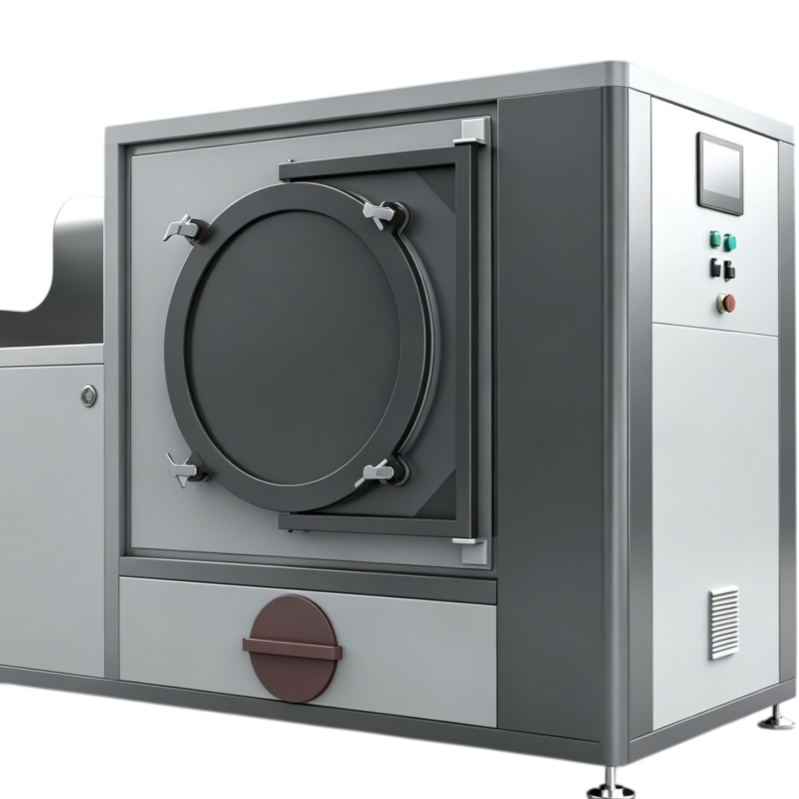
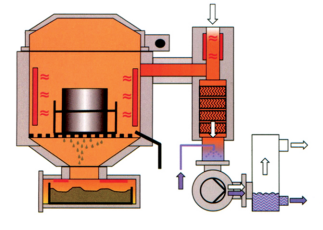
Stage 1 — Vacuum Thermal Melting (RT ~ 300°C, ~150 min) Dirty screens are loaded into the vacuum furnace, where residual polymer softens under controlled heating, melts, and drips into the bottom collection container. Operating under vacuum prevents oxidation of the screens, preserving their mechanical integrity for extended service life.
Stage 2 — High-Temperature Pyrolysis (300 ~ 450°C, ~360 min) The temperature is progressively raised to pyrolyze and decompose the remaining contaminants into volatile fractions. All waste gas generated is continuously extracted and treated via a water-spray scrubber and water-ring vacuum pump, ensuring clean, environmentally compliant exhaust.
Stage 3 — Oxidation Decomposition (450°C, ~60 min) A trace amount of air is introduced under partial vacuum, fully oxidizing and burning off carbonized residues — restoring the screen mesh to a bare-metal, contaminant-free state.
Stage 4 — High-Pressure Water Rinsing Screens are removed from the furnace and rinsed with high-pressure water, flushing away loose ash and residual debris from the mesh openings.
Stage 5 — Ultrasonic Fine Cleaning (30–60 min) Final deep cleaning in an ultrasonic tank removes microscopic particles from every mesh gap, delivering a metallic-clean surface ready for immediate reuse — with no chemical solvents, no screen damage, and minimal metal loss.
✅ High-efficiency vacuum thermal decomposition Controlled vacuum-heating process melts and decomposes plastic contaminants without damaging metal filter mesh structure. Avoids over-oxidation or deformation of filter screens.
✅ Two-stage cleaning workflow: thermal pyrolysis + ultrasonic finishing Heavy carbon-plastic dirt is eliminated by vacuum thermal furnace; ultrasonic treatment removes tiny residual particles, delivering near-new cleaning result.
✅ Wide compatibility for filter specifications Suitable for filter screens ranging from 8 mesh to 150 mesh, compatible with filter discs for various screen changers in plastic extrusion & recycling plants.
✅ Precise temperature control Temperature control accuracy reaches ±1 ℃; working temperature adjustable up to 500 ℃, max design temperature 650 ℃. Supports custom temperature curves for different contamination levels.
✅ Safe & environmental-friendly exhaust treatment Process waste gas passes through water-spray scrubber system before discharge; prevents harmful fume pollution on-site.
✅ Reduce operational cost Recycle and regenerate blocked filter screens instead of frequent replacement. Greatly lowers consumable expenditure for plastic recycling and pelletizing workshops.
✅ Fully-automatic process option Pre-set heating & holding time parameters; equipment executes cleaning cycle automatically. Simple operation for workshop staff.
Item |
Specification |
Furnace chamber dimension |
Φ660 mm × 300 mm (Diameter × Depth) |
Working temperature |
Up to 500 ℃ (adjustable) |
Max design temperature |
650 ℃ |
Temperature control accuracy |
±1 ℃ |
Heating power |
4.5 kW |
Vacuum pump power |
1.1 kW |
Water inlet |
DN25, tap water ≥0.025 MPa |
Water outlet |
DN25, normal pressure, outlet water 40-50 ℃ |
Power supply |
380 V / 220 V, three-phase four-wire |
Applicable filter mesh |
8-150 mesh |
Item |
Specification |
Cleaning tank dimension |
L600 × W600 × H300 mm |
Tank material |
304 stainless steel |
Ultrasonic frequency |
28 KHz |
Ultrasonic power |
2 kW |
Single-batch cleaning duration |
30-60 min |
Recommended detergent |
Foam-free alkaline eco-friendly metal cleaner |
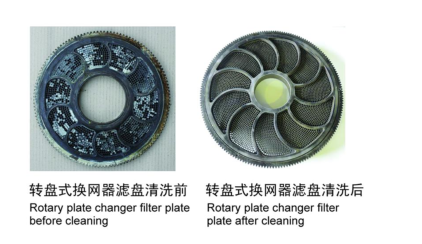
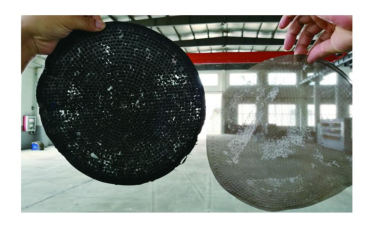
Before-and-after reference: Carbon-caked dirty filter discs can be restored to clean metallic condition after full KW500LH treatment for repeated service.

Suzhou Polytec Machine Co LTD delivers high-quality, customized waste plastic recycling systems. Our advanced technology and expert service optimize efficiency and sustainability for global clients.
Zhangjiagang City(Nearby Shanghai City ,One Hour By Train) ,Jiangsu Province,China 215621
Copyright © 2026 Suzhou Polytec Machine Co LTD . All rights reserved. Privacy Policy

 EN
EN