
 EN
EN


Achieving consistently high output quality in film recycling operations remains a critical challenge for recyclers seeking to maximize material value and meet stringent market specifications. The performance of film recycling machines directly influences the purity, cleanliness, and processing characteristics of recycled pellets, which ultimately determines their marketability and pricing. Modern film recycling machines incorporate sophisticated washing, separation, and drying technologies designed to remove contaminants while preserving polymer integrity, yet many facilities struggle to optimize these systems for peak performance. Understanding the interplay between machine design, operational parameters, and material characteristics enables recyclers to systematically enhance output quality while maintaining throughput efficiency.
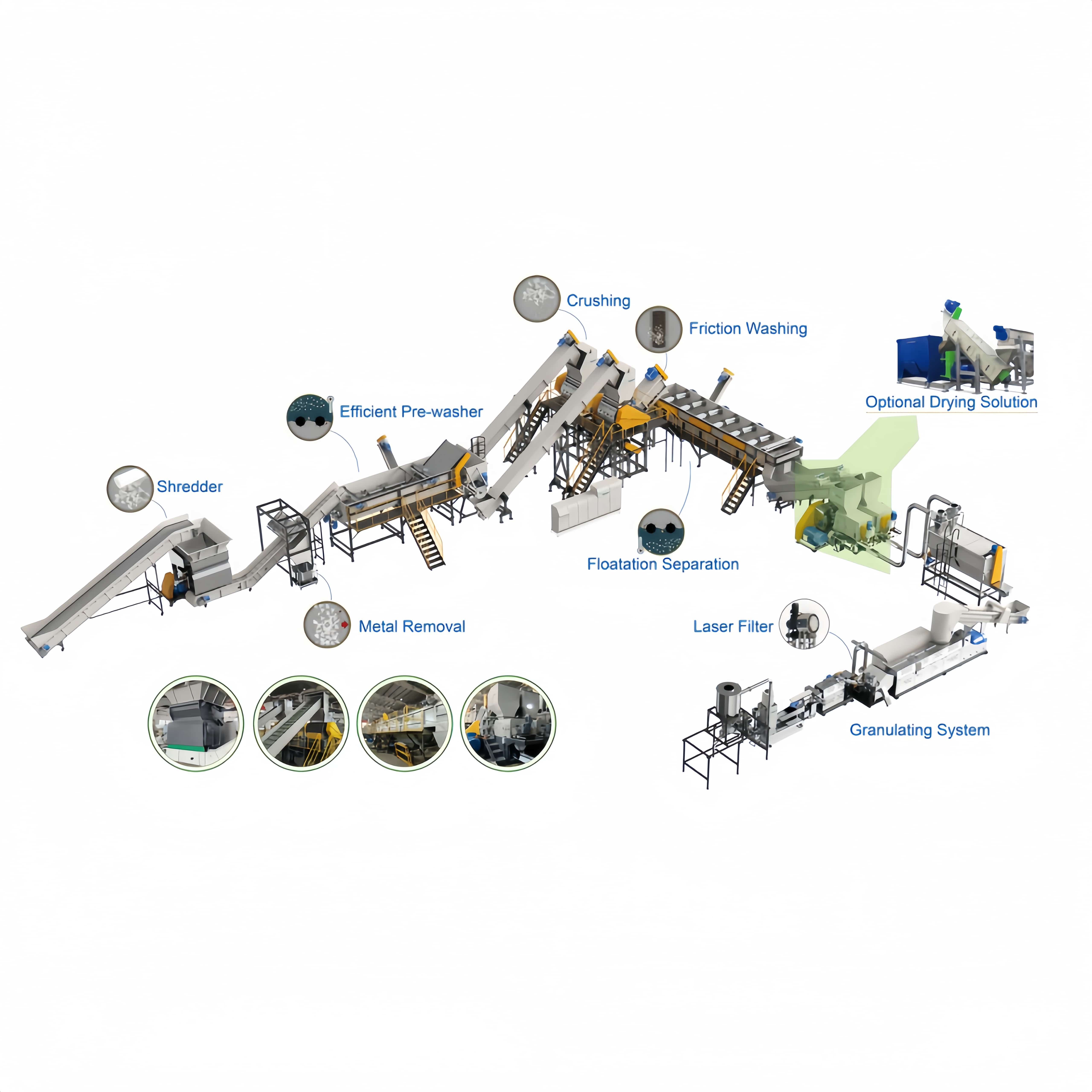
Improving output quality requires a comprehensive approach that addresses material preparation, machine configuration, process control, and quality monitoring throughout the recycling workflow. The journey from contaminated waste film to premium recycled flakes involves multiple processing stages, each presenting specific opportunities for quality enhancement. Recyclers who implement systematic improvements across washing intensity, separation efficiency, drying completeness, and contamination control can achieve dramatic improvements in final product specifications. This article explores proven methodologies for optimizing film recycling machines to deliver superior output quality that meets or exceeds market requirements for demanding applications.
Understanding Quality Determinants in Film Recycling Operations
Critical Quality Parameters for Recycled Film Output
The quality of output from film recycling machines is measured through several interconnected parameters that collectively define material value and application suitability. Moisture content represents a primary quality indicator, as excessive residual moisture compromises pelletization, creates processing difficulties, and promotes degradation during storage. Industry specifications typically require moisture levels below 2 percent for most applications, with premium grades demanding levels under 1 percent. Film recycling machines equipped with advanced mechanical and thermal drying systems achieve these targets through multi-stage moisture removal that progressively reduces water content without thermal degradation.
Contamination levels constitute another fundamental quality determinant, encompassing both particulate contaminants and residual non-polymer materials. Labels, adhesives, paper fragments, and other foreign materials must be reduced to trace levels, typically below 100 parts per million for quality-sensitive applications. Modern film recycling machines incorporate multiple separation stages including density separation, friction washing, and optical detection to systematically remove diverse contaminant types. The effectiveness of these systems directly impacts the purity of final output and determines whether recycled material can substitute for virgin resin in demanding applications.
Particle size distribution and flake geometry also significantly influence output quality from film recycling machines. Uniform flake size facilitates consistent feeding during extrusion, promotes even melting, and enables predictable processing behavior. Irregularly sized or excessively fine particles create processing complications including bridging in hoppers, inconsistent melt flow, and increased dust generation. High-performance film recycling machines utilize precision cutting systems and screening technologies to produce flakes within tight size specifications, typically ranging from 8 to 14 millimeters for optimal downstream processing. This dimensional consistency directly translates to improved pelletizing efficiency and more uniform final product properties.
Impact of Input Material Characteristics on Output Quality
The characteristics of incoming waste film profoundly influence achievable output quality regardless of machine sophistication. Material composition, contamination level, film thickness, and degradation state all affect how effectively film recycling machines can process and purify the feedstock. Multi-layer films containing barrier materials or incompatible polymers present particular challenges, as these structures may separate incompletely during washing, leading to contamination in the final output. Pre-consumer film scrap typically offers more consistent quality potential than post-consumer sources due to lower contamination levels and more uniform composition.
Contamination type and distribution within input material directly determines the washing intensity and separation stages required within film recycling machines. Organic contaminants like food residues or agricultural soil require hot washing with appropriate surfactants to achieve acceptable cleanliness levels. Inorganic contaminants including sand, metal fragments, or glass demand effective density separation and screening systems. Film recycling machines designed with modular washing stages allow operators to customize treatment intensity based on input material characteristics, optimizing both quality outcomes and operational costs.
Material degradation from weathering, UV exposure, or thermal history affects how film behaves during recycling and influences final output properties. Degraded films may become brittle during size reduction, generating excessive fines that complicate separation and washing. They may also exhibit reduced melt strength during subsequent processing, limiting application possibilities even when contamination is adequately controlled. Advanced film recycling machines incorporate gentle handling systems and controlled temperature profiles to minimize additional degradation during processing, preserving as much polymer integrity as possible for the final output.
Optimizing Washing System Performance for Superior Cleanliness
Configuring Multi-Stage Washing for Maximum Contaminant Removal
The washing system represents the heart of quality improvement in film recycling machines, as contaminant removal directly determines output purity and application suitability. Effective washing requires a systematic progression through pre-washing, intensive washing, and rinsing stages, each addressing specific contaminant categories. Pre-washing removes loose dirt and reduces contamination load before intensive treatment, preventing recontamination of cleaned material. Film recycling machines with dedicated pre-wash zones achieve significantly better final cleanliness by preventing contamination migration between processing stages.
Intensive washing stages within film recycling machines employ mechanical friction, chemical action, and temperature control to break contamination bonds and separate foreign materials from polymer surfaces. High-intensity friction washers generate turbulent flow conditions that scrub film surfaces while maintaining material in suspension to prevent settling and recontamination. Water temperature elevation to 60-80 degrees Celsius dramatically improves cleaning effectiveness by softening adhesives, liquefying oils, and enhancing surfactant performance. The residence time within intensive washing sections must be sufficient for thorough cleaning without causing excessive mechanical degradation or energy waste.
Rinsing stages following intensive washing remove residual detergents, dissolved contaminants, and suspended particulates that would otherwise dry onto clean flakes and compromise output quality. Film recycling machines incorporating counter-current rinsing systems achieve superior cleanliness with minimal water consumption by progressively exposing material to increasingly clean water. Final rinse water quality directly influences the cleanliness of dried output, making water management and filtration critical components of quality optimization. Advanced systems recirculate and progressively filter washing water to maintain effectiveness while reducing consumption and wastewater treatment requirements.
Selecting Appropriate Washing Chemistry and Operating Conditions
Chemical selection for washing stages in film recycling machines must balance cleaning effectiveness, equipment compatibility, environmental impact, and cost considerations. Surfactants reduce surface tension and enable water penetration into contaminated areas, dramatically improving organic contaminant removal. Alkaline additives enhance oil and grease removal while assisting in label and adhesive softening. However, excessive chemical use increases operating costs and complicates wastewater treatment without proportional quality benefits. Film recycling machines achieve optimal results when chemical dosing is precisely controlled based on contamination levels and water hardness characteristics.
Operating temperature represents a critical control parameter that significantly influences washing effectiveness in film recycling machines. Elevated temperatures accelerate chemical reactions, reduce adhesive bond strength, and improve contaminant solubility, enabling more thorough cleaning with shorter residence times. However, excessive temperature risks thermal degradation of certain polymer types, particularly in the presence of alkaline washing solutions. Film recycling machines designed with precise temperature control and monitoring systems allow operators to optimize thermal input for specific material types, maximizing cleaning effectiveness while preserving polymer properties.
Water quality used within film recycling machines affects both washing performance and potential for contamination introduction. Hard water containing dissolved minerals can precipitate onto film surfaces during drying, creating contamination that degrades output quality. Suspended solids in process water recontaminate cleaned material unless effectively removed through filtration or settling systems. Film recycling machines incorporating water treatment systems including filtration, softening, and recirculation achieve superior output quality while reducing fresh water consumption. Regular monitoring of water quality parameters enables proactive adjustment of treatment systems before output quality degradation becomes evident.
Enhancing Separation Efficiency to Eliminate Contamination
Optimizing Density Separation Systems for Foreign Material Removal
Density-based separation represents a fundamental technology within film recycling machines for removing contaminants with different specific gravity than the target polymer. Polyethylene and polypropylene films float in water, enabling effective separation from higher-density materials including polyethylene terephthalate, polyvinyl chloride, paper, and most inorganic contaminants. Film recycling machines employ this principle through sink-float tanks where agitation maintains material suspension while density differences drive separation. The effectiveness of these systems depends critically on proper flow velocity, retention time, and turbulence management to ensure complete separation without material loss.
Tank geometry and flow characteristics within film recycling machines significantly influence separation efficiency and quality outcomes. Adequate tank volume relative to throughput ensures sufficient residence time for density-driven separation to occur completely. Properly designed inlet and outlet configurations prevent short-circuiting where material bypasses the separation zone without adequate treatment. Film recycling machines incorporating baffles and flow directors create controlled circulation patterns that maximize separation effectiveness while preventing dead zones where contaminants accumulate. Regular inspection and cleaning of separation tanks maintains optimal hydraulic performance and prevents quality degradation from contamination buildup.
Material agitation intensity within separation systems of film recycling machines must be carefully balanced to maintain particle suspension without creating excessive turbulence that prevents settling of denser contaminants. Insufficient agitation allows material to clump and trap contaminants, while excessive turbulence keeps everything in suspension regardless of density. Advanced film recycling machines incorporate variable-speed agitators with adjustable blade configurations, enabling operators to optimize mixing intensity for specific material characteristics and contamination profiles. This flexibility proves particularly valuable when processing materials with borderline density differences that require precise control for effective separation.
Implementing Advanced Separation Technologies for Stubborn Contaminants
Certain contaminants present separation challenges that exceed the capabilities of basic density systems, requiring film recycling machines to incorporate additional separation technologies for quality optimization. Electrostatic separation exploits differences in electrical conductivity to separate materials with similar densities but different electrical properties. This technology proves particularly effective for separating polyethylene from polypropylene when both are present in mixed film streams. Film recycling machines equipped with electrostatic separators can achieve high-purity single-polymer outputs that command premium pricing and access quality-sensitive markets.
Metal detection and removal systems protect film recycling machines from damage while eliminating metallic contamination that severely compromises output quality. Metal fragments from packaging components, processing equipment wear, or collection contamination can damage downstream processing equipment and create defects in final products. Advanced film recycling machines incorporate magnetic separators for ferrous metals and eddy current separators or metal detectors for non-ferrous metals. These systems not only improve output quality but also reduce maintenance costs and unplanned downtime from equipment damage.
Optical sorting technology represents the frontier of contamination removal in high-performance film recycling machines, enabling polymer-specific sorting and contamination removal based on spectral characteristics. Near-infrared sensors identify material composition at high speed, triggering precise air jets that separate target materials from contaminants. While representing significant capital investment, optical sorting enables film recycling machines to process heavily contaminated or mixed feedstocks while maintaining premium output quality. This technology particularly benefits operations processing post-consumer films where contamination variability would otherwise limit achievable quality levels.
Maximizing Drying Effectiveness to Meet Moisture Specifications
Implementing Mechanical Dewatering for Initial Moisture Reduction
Moisture removal efficiency directly impacts both output quality and energy consumption in film recycling machines, making drying optimization a critical quality improvement focus. Mechanical dewatering represents the most energy-efficient moisture removal method, using physical force to expel water from material before thermal drying. Film recycling machines typically incorporate screw presses, centrifugal dryers, or vibrating screens for mechanical dewatering, reducing moisture content from saturation levels to approximately 10-15 percent. This mechanical stage dramatically reduces the thermal energy required for final drying, improving both operating economics and quality outcomes by minimizing thermal exposure.
Centrifugal dryers within film recycling machines generate high g-forces that drive water from material surfaces and interstices, achieving moisture reduction rates far exceeding gravitational drainage. Rotational speed, basket perforation size, and residence time all influence dewatering effectiveness and must be optimized for specific material characteristics. Film recycling machines with variable-speed centrifugal dryers enable operators to adjust processing intensity based on flake geometry, thickness, and initial moisture content. Proper maintenance of basket screens and bearing systems ensures consistent dewatering performance and prevents quality variation from equipment degradation.
Screen dewatering systems in film recycling machines provide continuous mechanical moisture removal with lower maintenance requirements than centrifugal systems, though typically achieving slightly higher residual moisture levels. Vibrating or rotating screens allow water drainage while conveying material toward subsequent processing stages, integrating material handling with dewatering functions. Screen aperture size must be selected to prevent material loss while maximizing drainage effectiveness. Film recycling machines incorporating multi-deck screen systems achieve progressive moisture reduction with increased total screen area, optimizing the balance between footprint, capital cost, and dewatering performance.
Designing Thermal Drying Systems for Final Moisture Removal
Thermal drying systems in film recycling machines reduce moisture content to final specification levels required for subsequent processing and storage stability. Hot air dryers represent the most common thermal drying technology, circulating heated air through material beds or fluidized layers to evaporate residual moisture. The effectiveness of thermal drying depends on air temperature, velocity, residence time, and material distribution within the drying chamber. Film recycling machines with multi-zone thermal dryers enable progressive temperature increase and optimized residence time distribution, achieving target moisture levels with minimal thermal exposure and energy consumption.
Air temperature selection in thermal dryers for film recycling machines must balance drying effectiveness against thermal degradation risk. Higher temperatures accelerate moisture evaporation but increase oxidation, polymer degradation, and potential for discoloration. Most polyolefin films tolerate drying temperatures up to 90-110 degrees Celsius without significant degradation when exposure time remains controlled. Film recycling machines incorporating temperature profiling with cooler initial zones and hotter final zones optimize moisture removal while minimizing thermal stress on material. Continuous temperature monitoring and control prevents excursions that could compromise output quality through degradation or incomplete drying.
Residence time distribution within thermal dryers significantly influences both moisture removal completeness and throughput capacity of film recycling machines. Insufficient residence time leaves excessive moisture in output, causing processing difficulties and potential for microbial growth during storage. Excessive residence time wastes energy and reduces throughput without corresponding quality benefits. Film recycling machines designed with adjustable conveying speeds or variable retention volumes enable operators to optimize residence time for specific material characteristics and target moisture specifications. Regular verification of moisture content in dried output confirms system effectiveness and enables proactive adjustment before quality issues reach customers.
Implementing Quality Control Systems for Consistent Output
Establishing Real-Time Monitoring of Critical Quality Parameters
Continuous quality monitoring enables operators of film recycling machines to detect variations before they result in off-specification output, minimizing waste and maintaining customer satisfaction. Moisture sensors installed at dryer outlets provide immediate feedback on drying system performance, allowing rapid adjustment of temperature, air flow, or residence time to maintain target specifications. Modern film recycling machines incorporate automated moisture monitoring with alarm systems that alert operators to deviations, preventing accumulation of wet material that would require reprocessing or could degrade during storage.
Color monitoring systems detect contamination and degradation issues in output from film recycling machines before material reaches packaging and shipment. Spectrophotometric sensors measure color values continuously, comparing them to established specifications and triggering alarms when deviations occur. Color shifts may indicate inadequate washing, contamination introduction, or thermal degradation during processing. Film recycling machines with integrated color monitoring enable immediate investigation and correction of process deviations, maintaining consistent output quality across production runs and preventing customer complaints.
Metal detection systems at final output points of film recycling machines provide critical quality assurance by identifying metallic contamination that escaped earlier separation stages. Even small metal fragments can cause equipment damage during subsequent processing or create defects in final products manufactured from recycled flakes. Advanced film recycling machines incorporate reject systems that automatically divert contaminated material when metal is detected, preventing contamination of larger output quantities. Regular testing with calibrated metal samples verifies detector sensitivity and ensures reliable contamination prevention.
Implementing Statistical Process Control for Quality Consistency
Statistical process control methodologies enable operators of film recycling machines to distinguish normal process variation from significant deviations requiring intervention. Regular sampling and testing of output for moisture content, contamination levels, bulk density, and particle size distribution generates data that reveals process trends and variation patterns. Control charts displaying these parameters over time make deviations immediately visible, enabling proactive adjustment of film recycling machines before output quality drifts outside specification limits. This systematic approach prevents both unnecessary intervention in response to normal variation and delayed response to actual quality issues.
Correlation analysis between operating parameters and quality outcomes enables optimization of film recycling machines through data-driven decision making. Tracking relationships between washing temperature and contamination levels, dryer residence time and moisture content, or throughput rate and separation efficiency reveals optimal operating conditions for quality maximization. Film recycling machines equipped with data logging systems facilitate this analysis by capturing operating parameters alongside quality measurements, creating the information foundation for continuous improvement initiatives. Regular review of these relationships identifies opportunities for process refinement and quality enhancement.
Process capability analysis quantifies the ability of film recycling machines to consistently meet quality specifications under normal operating conditions. Calculating capability indices from quality measurement data reveals whether process variation fits comfortably within specification limits or whether frequent excursions should be expected. Low capability indices indicate the need for process improvement through equipment upgrade, parameter optimization, or tighter process control. Film recycling machines with high process capability deliver consistent quality that meets customer requirements with minimal sorting, rework, or rejection, optimizing both quality outcomes and operational efficiency.
FAQ
What moisture content should be targeted in film recycling machine output?
Target moisture content for output from film recycling machines typically ranges from 1 to 2 percent depending on subsequent processing requirements and storage conditions. Applications involving immediate extrusion may tolerate slightly higher moisture levels around 2 percent, while material intended for storage or transport should achieve levels below 1.5 percent to prevent degradation and microbial growth. Premium applications demanding optimal processing characteristics require moisture content below 1 percent. Achieving these targets requires effective mechanical dewatering followed by properly designed thermal drying systems with adequate residence time and temperature control. Regular moisture testing of output confirms drying system effectiveness and enables adjustment to maintain specifications.
How does washing temperature affect output quality in film recycling?
Washing temperature significantly influences contaminant removal effectiveness in film recycling machines, with elevated temperatures improving cleaning performance through multiple mechanisms. Higher temperatures soften adhesives and labels, facilitate oil and grease removal, enhance surfactant effectiveness, and increase contaminant solubility. Most film recycling operations achieve optimal results with washing temperatures between 60 and 80 degrees Celsius, balancing cleaning effectiveness against energy costs and equipment requirements. However, excessive temperatures above 85 degrees Celsius risk thermal degradation of certain polymer types and may cause premature equipment wear. The optimal washing temperature depends on contamination type, film composition, and equipment capabilities, requiring adjustment based on specific material characteristics.
What causes color variation in recycled film output and how can it be prevented?
Color variation in output from film recycling machines typically results from incomplete contamination removal, thermal degradation during processing, or mixing of different polymer types or colors. Inadequate washing leaves colored labels, inks, or other contaminants attached to flakes, creating color contamination in the final output. Excessive thermal exposure during drying or inadequate oxidation protection causes yellowing or browning, particularly in materials that have experienced prior degradation. Mixing of different colored films without effective sorting creates blended colors in output. Prevention requires thorough washing system optimization, careful temperature control throughout processing, effective separation of incompatible materials, and potentially color-based sorting of input materials. Film recycling machines with advanced monitoring and control systems enable operators to detect and correct color issues before significant quantities of off-specification material are produced.
How frequently should film recycling machines be cleaned to maintain output quality?
Cleaning frequency for film recycling machines depends on material characteristics, contamination levels, and processing intensity, but most operations benefit from daily cleaning of critical components and weekly deep cleaning of entire systems. Friction washers, separation tanks, and screen systems accumulate contamination residues that gradually reduce effectiveness and can recontaminate clean material if not regularly removed. Daily flushing of washing circuits and inspection of separation zones prevents buildup that compromises quality. Weekly disassembly and thorough cleaning of friction washers, pump screens, and dryer filters maintains optimal performance. Material transitions between different film types or contamination levels require intermediate cleaning to prevent cross-contamination. Establishing cleaning protocols based on process monitoring and quality tracking ensures film recycling machines maintain consistent output quality while minimizing unnecessary downtime from excessive cleaning.
Table of Contents
- Understanding Quality Determinants in Film Recycling Operations
- Optimizing Washing System Performance for Superior Cleanliness
- Enhancing Separation Efficiency to Eliminate Contamination
- Maximizing Drying Effectiveness to Meet Moisture Specifications
- Implementing Quality Control Systems for Consistent Output
-
FAQ
- What moisture content should be targeted in film recycling machine output?
- How does washing temperature affect output quality in film recycling?
- What causes color variation in recycled film output and how can it be prevented?
- How frequently should film recycling machines be cleaned to maintain output quality?